
Population Genetics of Wolffishes
PhD project, Megan McCusker
Conservation Concerns
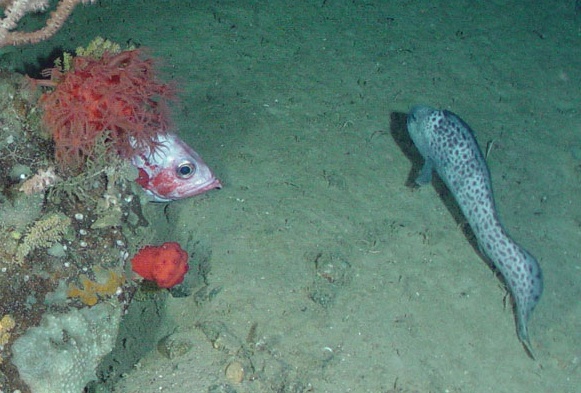
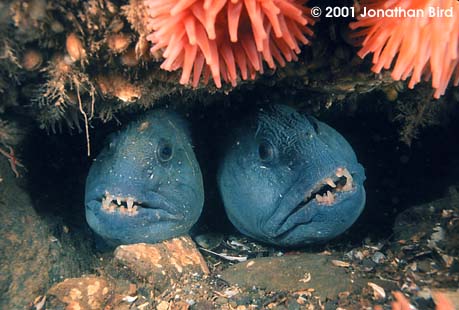 Many of these life history characteristics that make wolffishes interesting also make them particularly vulnerable to fishing mortality and habitat degradation by trawl nets. Due to a combination of extensive habitat degradation and by catch in other fisheries, wolffishes in the Atlantic Ocean have suffered severe population declines since the 1970s. All three species of wolffishes in the Atlantic are currently listed under the Canadian Species at Risk Act (SARA) as either special concern (Atlantic wolffish, Anarhichas lupus) or threatened (spotted wolffish, A. minor, and northern wolffish, A. denticulatus).
Recent research
 Our research goals were to assess the genetic variation of all three wolffish species in the North Atlantic to better understand their evolutionary history and adaptive potential. We were particularly interested in three broad areas of research: phylogeography, population structure, and selection, which were addressed using an array of genetic markers: mitochondrial DNA (mtDNA), microsatellites and amplified fragment length polymorphisms (AFLP).
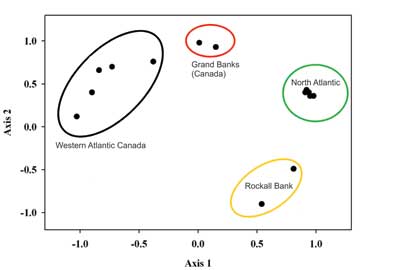
Our research on wolffishes yielded some surprising results. Contrary to our expectations based on what was known about the biology of these species, all three species of wolffish showed only weak population genetic structure. For example, Atlantic wolffish populations across most of the North Atlantic appeared relatively genetically homogeneous; however, populations in Atlantic Canada and on the Rockall Bank (an isolated sea mount halfway between Ireland and Iceland)were significantly different from those in the rest of the species range (Figure 1).
Mitochondrial DNA sequence data indicated that all western Atlantic populations of all three species of wolffish are the result of post-glacial dispersal from one or more refugia in the eastern Atlantic.
Wolffish publications
McCusker, M.R. and P. Bentzen. 2011. Limited population structure in Northern and Spotted Wolffishes (Anarhichas denticulatus and A. minor) despite low apparent dispersal potential. Marine Biology DOI 10.1007/s00227-011-1698-3
McCusker, M.R. and P. Bentzen. 2010. Historical influences dominate the population genetic structure of a sedentary marine fish, Atlantic wolffish (Anarhichas lupus), across the North Atlantic Ocean. Molecular Ecology 19(19):4228-4241.
McCusker, M.R. and P. Bentzen. 2010. Phylogeography of three North Atlantic wolffish species (Anarhichas spp.) with phylogenetic relationships within the family Anarhichadidae. Journal of Heredity doi: 10.1093/jhered/esq062
McCusker, M.R. 2009. The demographic history and population structure of three species of wolffishes across the North Atlantic Ocean. PhD thesis,Department of Biology, Dalhousie University, Halifax, Canada. 203 p.
McCusker, M.R., I.G. Paterson and P. Bentzen. 2008. Microsatellite markers discriminate three species of North Atlantic wolffishes (Anarhichas spp.). Journal of Fish Biology 72:375-385.
COSEWIC status reports: Atlantic Wolffish,
Northern Wolffish,
Spotted Wolffish